Tomahawk of the Serpent
The Legend of William OhTomahawk of the Serpent is a magic weapon that repeatedly enlarges the meaning of what a weapon can do. In William Oh’s hands, it is an axe, a psychic instrument, a negotiation guarantor, and finally an implement of execution. Its most decisive feature is not merely its combat output but its ability to make an agreement materially binding: shared smoke seals the pact, and deliberate violation brings a month-long punishment. The weapon therefore joins speech to consequence, making trust enforceable while leaving violence as its ultimate answer.
Form and Core Abilities
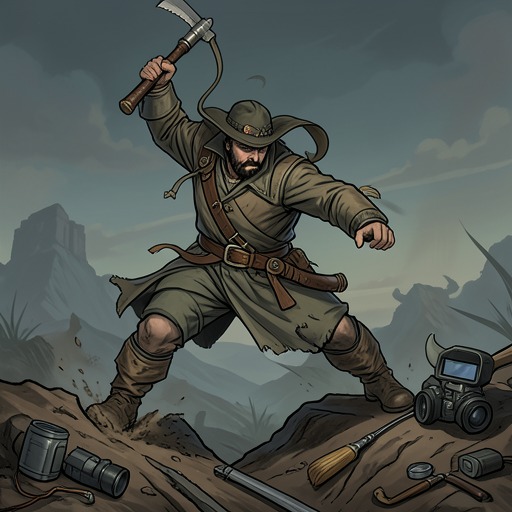
Tomahawk of the Serpent first appears as an axe whose unusual construction conceals a second function. William Oh initially remembers only that he has not examined its description because he has been too occupied with staying alive. When he focuses on the weapon, the system identifies it as Tomahawk of the Serpent and reveals that its swing creates a venomous chord. Enemies who hear that chord receive a three-percent debuff to their statistics, with each debuff lasting three seconds.
Its first charged ability expands the weapon’s reach beyond the blade. One charge releases a sound-based attack with a twenty-foot radius, inflicting a small amount of psychic damage on every enemy within range. Psychic damage is especially valuable in the book’s combat system because it has no interaction with other damage types and completely disregards physical defenses. Steve recognizes that property when he examines William Oh’s axe, immediately understanding that the weapon is far more exceptional than anything normally found on the First Floor.
The axe’s construction makes its design easy to underestimate. William Oh notices a hole in the bowl-shaped back of the blade and realizes that it is also a pipe. The discovery reframes the object: the pipe is not decorative, and the weapon is not simply an axe with an incidental enchantment. Its apparently contradictory identities are integrated into its abilities, allowing sound, smoke, debuffs, psychic force, and physical violence to occupy the same artifact.
The Agreement-Sealing Charge
The Tomahawk of the Serpent’s second charged function is its most consequential ability. One charge may be used to seal an agreement between two people by having them share smoke from the pipe. Anyone who willingly violates the spirit of that agreement suffers three times the weapon’s passive debuff for one month. The rule is notable for enforcing not only literal wording but the “spirit” of a pact, giving the weapon a quasi-judicial force that depends on intention as well as action.
This ability transforms an otherwise uncertain promise into an operative event. The shared smoke is both a ritual and a trigger: the agreement becomes effective through a physical act, while the later curse supplies the consequence. The weapon thus makes speech performative in the strictest sense. A person does not merely describe a promise; through the Tomahawk of the Serpent, the promise becomes a condition imposed on the body and capabilities of anyone who breaks it.
William Oh immediately recognizes the economic importance of this power. He estimates that the weapon would likely be worth at least one thousand gold solely because of the agreement-sealing ability. Yet he has no intention of selling it. The decision establishes the weapon as a personal strategic asset rather than ordinary loot. Its worth is measured not only by what it can kill, but by what it can compel people to do after they agree to live by its terms.
Use in Negotiation and Crisis
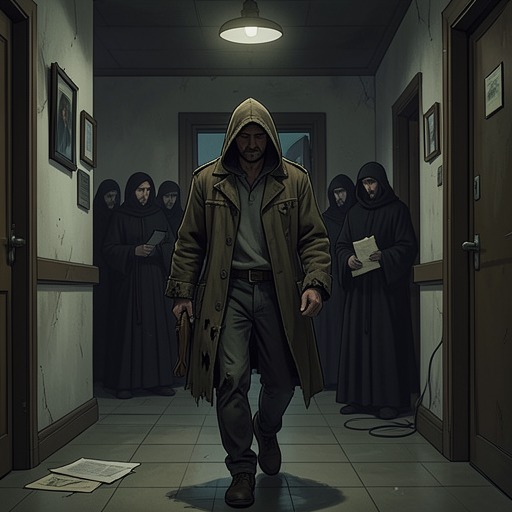
The agreement ability becomes practical when William Oh confronts a priest who is about to be killed. With the Tomahawk of the Serpent raised toward the priest’s neck, William’s threat creates the immediate pressure needed to obtain information about a hidden stash. The priest asks for a guarantee that he will not be killed, and William looks at the axe before devising a solution. The weapon’s contract function lets him offer a guarantee without relying on goodwill alone.
The scene reveals the weapon’s central irony. It can make a promise credible, but credibility emerges under the shadow of a blade. The axe does not replace coercion with trust; it allows coercion to formalize trust into an enforceable bargain. The priest’s request, William’s response, and the weapon’s ability form a compact sequence in which language becomes another kind of combat maneuver. The Tomahawk of the Serpent is therefore most powerful when the boundary between negotiation and threat has already become unstable.
The same feature also imposes a limit on the people who use it. Because the penalty is tied to knowingly violating the spirit of an agreement, the weapon cannot simply guarantee any interpretation William wants after the fact. Its power depends on the pact being made and on the parties’ willingness to enter it. That dependence gives the artifact a social dimension: it operates through consent, but preserves that consent with supernatural punishment.
William Oh’s Tactical Reassessment
William Oh does not treat the Tomahawk of the Serpent as a fixed lifelong build choice. When he examines a magic sickle that inflicts Hoarfrost, he considers stripping the enchantment and transferring it to his Phantom Hand. Hoarfrost slows a victim’s attack and movement by thirty percent as crystals grow around the joints, but it also increases bludgeoning damage against the victim while interfering with slashing and fire damage. Because the sickle’s effect actively makes its own later attacks less effective, William sees a possible way to place the debuff on a separate weapon and then exploit it with a better one-handed bludgeoning weapon.
That calculation clarifies the Tomahawk of the Serpent’s role in William’s equipment strategy. He values the axe, but he does not confuse possession with obligation. The weapon is powerful because of its psychic damage, passive debuff, and contract function; it is not necessarily the final answer to every possible combination of enchantments. William’s willingness to imagine replacing or augmenting it shows a Climber who evaluates relics as systems of interacting effects rather than as emotionally fixed treasures.
The weapon’s ranged potential also broadens that strategic uncertainty. When William sees the value of an item associated with the Scout and Ranger subtype, he realizes that a future ranged secondary ability could make such equipment extraordinarily important. The episode does not change the Tomahawk of the Serpent itself, but it places the axe within a larger question about build development: its current usefulness must be weighed against abilities William has not yet acquired. The weapon is valuable precisely because it remains flexible across combat, defense, and social leverage.
Violence, Consequence, and Significance
The Tomahawk of the Serpent ultimately returns to its most direct function as a killing weapon. In a later crisis, William apologizes before drawing the Serpent’s Tomahawk and killing a restrained Climber. He buries the tomahawk in the boy’s skull and then severs his spine to ensure the death, while the weapon’s wooden handle creaks under his grip. The moment strips away the artifact’s cleverness and exposes the physical fact beneath its systems of contracts and abilities: it is still a blade used to end a life.
That recurrence gives the object a severe structural tension. Earlier, its smoke enables a guarantee and its sound ignores physical defenses; later, its edge delivers an irreversible decision. The same artifact can make words binding or make a body still. Its significance comes from this continuity rather than from a simple progression from tool to symbol. In William Oh’s story, the weapon is a material node where rules, strategy, bargaining, and moral cost meet.
Tomahawk of the Serpent also embodies the book’s larger treatment of magic as both opportunity and constraint. The system displays charges and abilities as explicit rules, but William’s survival depends on recognizing uses that are not obvious from the weapon’s appearance. The pipe hidden in the axe becomes a contract mechanism; the sound of a swing becomes a statistical debuff; psychic damage becomes a way around physical defense. The artifact rewards interpretation, yet every use carries consequences. It is powerful not because it abolishes the dangers of the Climb, but because it lets William convert overlooked details into leverage—until leverage, negotiation, and violence become impossible to separate.